

Nonunion Programs Have Failed to Meet Demands for Skilled Labor
La Grange, IL: Alongside historic investments in infrastructure, energy systems, and domestic manufacturing, registered apprenticeships in Wisconsin’s construction industry have increased by nearly 50% over the past eight years, but this growth has lagged neighboring states that maintained policies that promote workforce training investments—according to a new study by the nonpartisan Midwest Economic Policy Institute (MEPI) and the Project for Middle Class Renewal (PMCR) at the University of Illinois at Urbana-Champaign. The report finds that joint labor-management programs affiliated with building trades unions are attaching the lion’s share of new workers to careers in the industry, and delivering graduation rates and job quality that rival Wisconsin’s four-year public universities.
Read the report, Registered Apprenticeship Programs in Wisconsin’s Construction Industry: The Joint Labor-Management Advantage.
“At a time when the construction industry faces high demand for qualified tradespeople to modernize infrastructure, energy systems, and manufacturing facilities, this study provides an important assessment of the performance of Wisconsin’s workforce development institutions and their interaction with recent changes in state labor policy,” said MEPI Economist and study coauthor Frank Manzo IV. “The data makes clear that the joint labor-management system is punching well above its weight to deliver the skilled workforce supply that Wisconsin’s construction industry needs, and the job quality that its economy demands.”
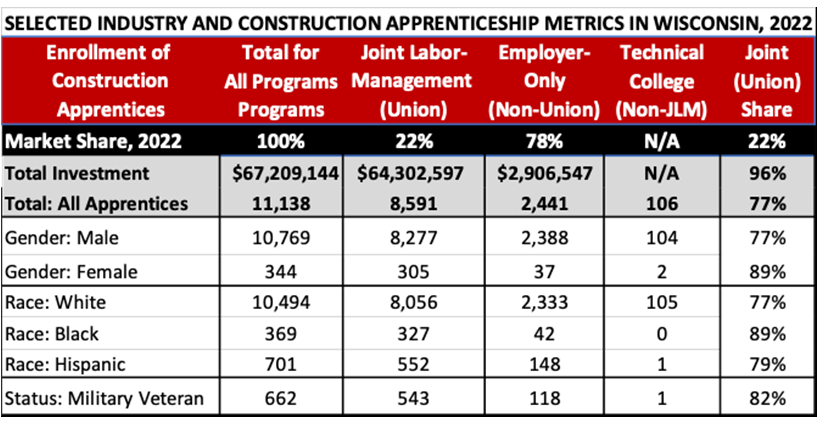
Though just 22% of Wisconsin’s construction industry is unionized, the study shows that training programs jointly administered by unions and signatory contractors enroll 77% of Wisconsin’s construction apprentices and account for 96% of all apprenticeship investments across the state—generating $64 million in total annual revenue compared to less than $3 million from employer-only nonunion programs. Joint labor-management programs also boast completion rates that are 9% higher than employer-only, or nonunion, programs. It notes that the state’s joint apprenticeship programs not only deliver superior quantities and diversity of construction trade workers, but also leave participants entirely free of student debt, have graduation rates on par with the University of Wisconsin System, and deliver median exit wages of $41 per hour that exceed those for most other workers.
Study authors noted that the differences in program investment and outcomes underscored a key distinction in the workforce development models within the industry. For example, the joint model institutionalizes financing for apprenticeship training through a “cents per hour” contribution in collective bargaining agreements, whereas the employer-only model relies on voluntary contributions from employers who may have incentives to forgo longer-term workforce investments in order to lower project bids and win work in the short term.
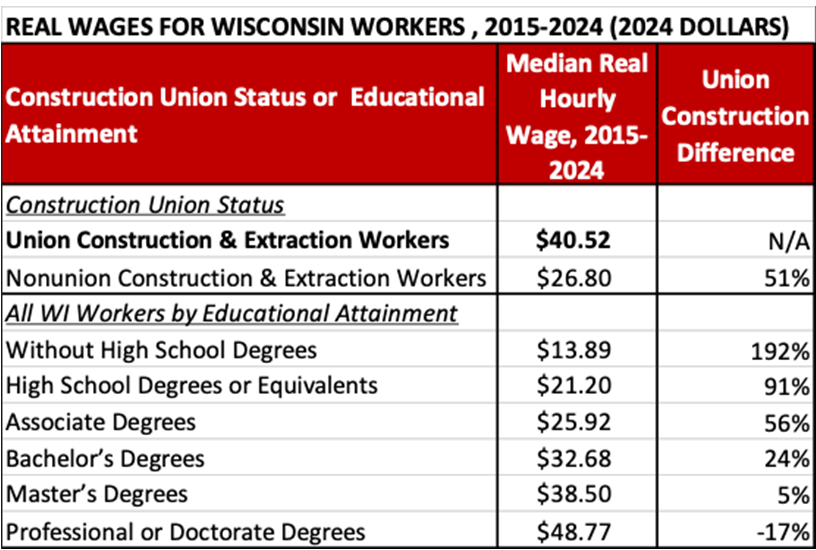
“Interestingly, there is a growing body of research that suggests the employer-only model of voluntary workforce training may actually increase construction costs,” added MEPI Research Analyst and study coauthor Jacob Hager. “Industry surveys have shown that skilled labor shortages that can delay projects are far more pervasive in the nonunion side of the industry. Similarly, research has documented that projects completed by nonunion firms are more likely to suffer from safety problems and lower levels of worker productivity, linking these issues with lower wage rates and underinvestment in apprenticeship training.”
While Wisconsin’s registered apprenticeship system has expanded over the past decade, researchers note that this growth has lagged Midwestern neighbors that maintained prevailing wage laws by nearly 14%. Prevailing wage laws establish market-specific minimum wages for different types of public construction work, which include hourly contributions into registered apprenticeship programs. Research has found they boost construction apprentice enrollments by as much as 8%. In 2017, Wisconsin repealed its prevailing wage laws.
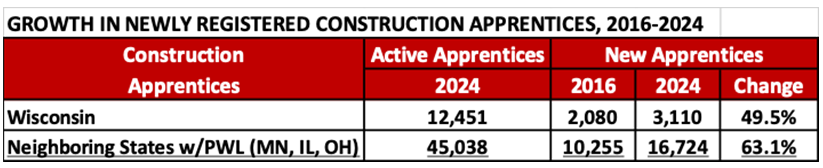
Study authors also cite another policy intervention by state lawmakers: passage a so-called “right-to-work” law, which weakened unions. “Right-to-work” has been linked to labor unions having fewer members and resources with which to bargain with employers over terms that include training contributions.
“While increased public investment in the construction sector is having a positive impact on the apprenticeship system, it is clear that state policy interventions that erode workforce institutions that prioritize training have had the opposite effect,” concluded University of Illinois at Urbana-Champaign Professor and PMCR Director Dr. Robert Bruno. “To meet surging demand, the data supports a reversal of these interventions as well as new investments in pre-apprenticeship programs to provide more workers with foundational skills needed to pursue careers in the skilled trades and tax credits to incentivize more employers to invest in our long-term domestic labor supply.”
###

The Midwest Economic Policy Institute (MEPI) is a nonpartisan nonprofit organization which uses advanced statistics and the latest forecasting models to promote economic growth for businesses and working families across the Midwest.
The Project for Middle Class Renewal (PMCR) at the University of Illinois at Urbana-Champaign investigates the working conditions of workers in today’s economy to elevate public discourse aimed at reducing poverty, create more stable forms of employment, and promote middle-class jobs.