
Blog
By Frank Manzo IV
When it comes to building out the infrastructure projects of the future, there is a right way and a wrong way to attract and develop workers. Meta, the owner and operator of Facebook and Instagram, is doing both.
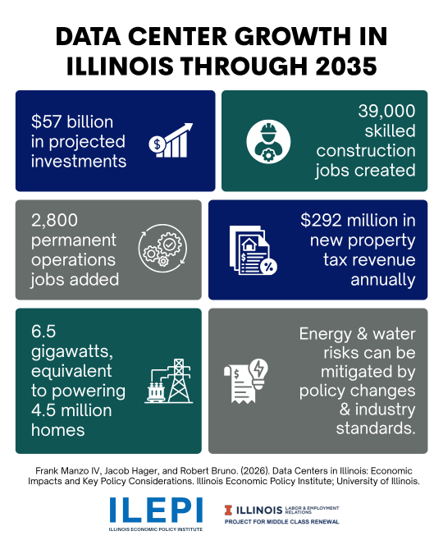
Data centers offer substantial job opportunities for construction workers. In Illinois over the next decade, the data center buildout is expected to employ 39,000 skilled tradespeople in Illinois earning $116,500 in average annual wages. Many workers experience 25%-30% pay bumps by working on data center projects. Researchers estimate that the United States needs between 63,000 and 140,000 more electricians, laborers, operating engineers, pipefitters, and welders in the next five years to build out AI infrastructure.
The solution is U.S. Department of Labor-approved registered apprenticeship programs.
Registered apprenticeships are training programs in which participants “earn while they learn” and obtain nationally-recognized credentials debt-free, with tuition costs covered by employers or joint labor-management organizations from collective bargaining agreements. These programs have expanded rapidly, nearly doubling over the past decade and rising to 25,000 actively enrolled apprentices in Illinois.
For its part, Meta recently entered into two very different agreements to address its construction workforce needs. Meta partnered with North America’s Building Trades Unions (NABTU) in August 2026 to supply skilled tradespeople after launching a $115 million initiative called America’s Workforce Academy in June 2026. There is good reason to be optimistic about the effectiveness of the NABTU agreement but skeptical that the Academy will have an impact.
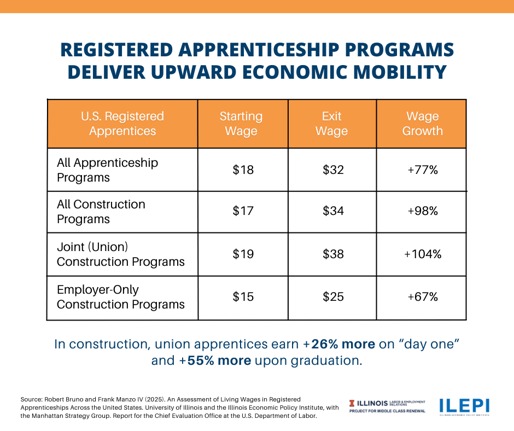
Union-affiliated apprenticeship programs typically require 6,000 to 8,000 hours of on-the-job and classroom training and offer journeyworker wages that are on par with—or even exceed—bachelor’s degrees. In Illinois, union apprentices start at $25 per hour on “day one” and graduate earning $50 per hour. Across the country, union-affiliated programs also have completion rates that are 10% higher and participant wages that are $13 per hour higher than nonunion programs in construction. Because the workforce is better trained, union worksites average 35% fewer health and safety violations nationally and 52% fewer violations in Illinois. That’s what the NABTU partnership will deliver for apprentices constructing Meta’s data centers.
Meta’s America’s Workforce Academy, on the other hand, is affiliating with the Associated Builders and Contractors, an organization with a dismal apprenticeship track record—posting the lowest completion rate among apprenticeship sponsors, including just 27% completion in Indiana. It also has a history of advocating for immigrant guest-worker programs instead of investing locally in U.S. citizens to address labor shortages.
America’s Workforce Academy is reportedly only a 4- to 5-week training program. This pales in comparison to the 4 to 5 years of apprenticeship training for union electricians and other skilled tradespeople. A worker from this initiative may only be able to build data centers, whereas a union electrician can perform the full scope of electrical work including the data center itself, the solar panels powering it, the electrical transmission lines connecting it to the grid, the temporary streetlights needed to accommodate new traffic at the site, and the electrical wiring in public schools receiving millions of dollars in new property tax revenues.
Throwing barely trained, lower-paid workers at these large, complex projects will invite safety problems, shoddy workmanship, and energy inefficiency. Instead, Big Tech corporations could focus entirely on bolstering the superior union-affiliated model of training.
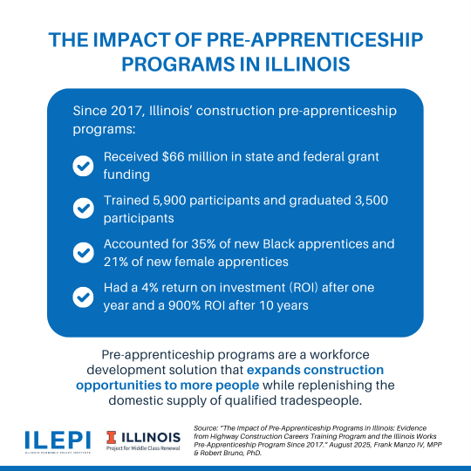
In fact, a better use of Meta’s $115 million for short-term training would be to invest in pre-apprenticeship programs. Pre-apprenticeships are precursors to registered apprenticeship opportunities and typically range from 6 to 18 weeks of paid training. These programs work as intended, creating pathways into registered apprenticeships and a skilled labor pipeline for the construction industry, and offer a high return on investment that is unmatched by other workforce development initiatives.
The devil is in the details. In Illinois, pre-apprenticeship programs invested $66 million to train about 6,000 participants and graduated at least 3,500 from 2017 to 2024. This works out to about $19,000 per graduate. By contrast, Meta expects to graduate 3,300 participants in its first year from a $115 million investment, which works out to $35,000 apiece. That’s nearly twice the cost for each graduate.
So while the America’s Workforce Academy initiative may initially sound good in a TV commercial or podcast advertisement, it is incredibly inefficient compared to pre-apprenticeships and is no match for union-affiliated apprenticeship programs. That’s why other tech companies like Microsoft and OpenAI decided to partner with construction unions, which can ramp up to meet the demand for tens of thousands of additional apprentices.
Whether it is Meta, Microsoft, or another multi-trillion-dollar corporation and whether it is data centers, energy infrastructure, or roads and bridges, expanding union-affiliated registered apprenticeship programs is a top priority. These programs produce productive, safe, and skilled local tradespeople who earn living wages in middle-class careers. To boost registered apprenticeships, federal and state lawmakers should enact policies that strengthen collective bargaining rights and encourage more employer-union cooperation.
Simply put, strong partnerships between businesses and unions are the most effective framework for delivering taxpayer-funded and privately financed infrastructure projects at scale.