
Blog
By Jacob Hager
Act 10, the law restricting Wisconsin public-sector employees’ bargaining rights, has come back to the forefront of politics in the Badger State. In 2024, a state circuit judge struck down much of Act 10 for being unconstitutional, only for the law to be reinstated by a state appeals court in July 2026.
In 2011, former Wisconsin Governor Scott Walker signed Act 10 into law. The legislation effectively nullified collective bargaining for most public sector employees, restricting bargaining items to base wages only and capping raises at no more than the rate of inflation while limiting overtime and pay schedules. Act 10 was followed by a statewide, so-called “right-to-work” law, signed by Governor Walker in 2015. Right-to-work laws allow nonunion workers to reap the benefits of collective bargaining without paying dues or fees, thereby limiting the resources unions would otherwise have available to bargain for higher job quality or organize new workers.
Research consistently shows that in states that promote collective bargaining, all workers do better—union and non-union workers alike. Wages and homeownership rates are higher, and workers have more money to spend across all sectors of the economy. And that creates a rising tide that lifts all boats. Stronger unions also tend to mean fewer workers reliant on state-sponsored assistance programs like food stamps and Medicaid.
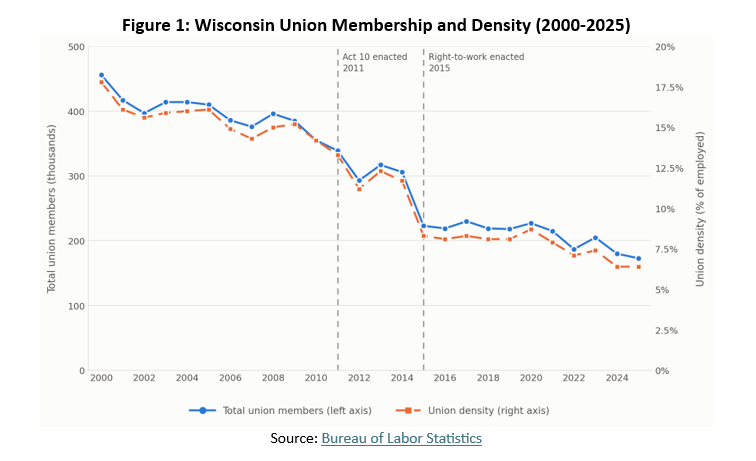
Yet both Act 10 and right-to-work have had detrimental effects on unions in Wisconsin. A recent economic research report found that Wisconsin had the largest decline in unionization of any state in the last 40 years, with Act 10 and right-to-work laws accelerating the collapse in organized workplaces. Figure 1 shows that, in 2025, the number of Wisconsin union workers sat at 173,000, or only 6.4 percent of the state’s workforce. Both numbers are less than half of their 2010 levels (355,000 members and 14.2 percent), the year before Act 10 was enacted.
This decline in bargaining power has had material consequences for workers across Wisconsin and the Midwest. Right-to-work laws are well understood to have far-reaching negative economic impacts. Wisconsin has seen these effects firsthand , producing 7 percent slower wage growth and a 4 percent lower labor force participation rate than states without right-to-work laws.
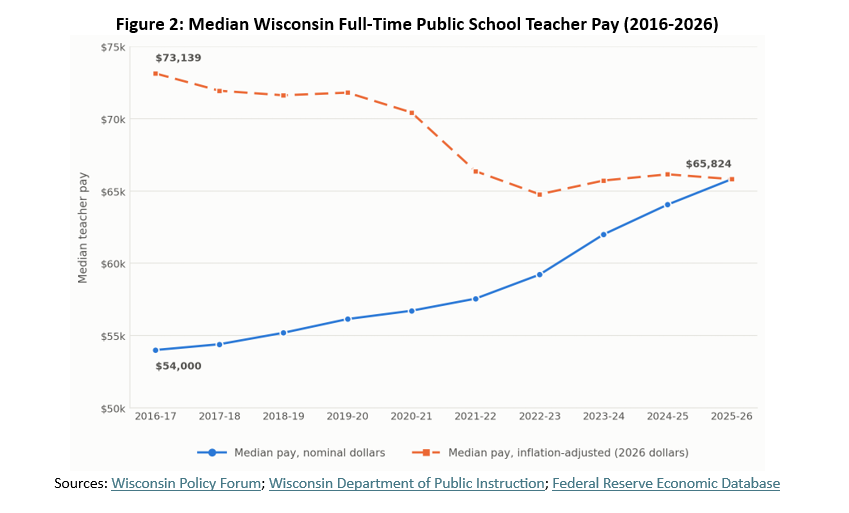
Act 10 has been especially harmful for Wisconsin teachers, whose earnings and benefits have been significantly impacted by the loss of collective bargaining. Median teacher salaries are lower than the national average across all education levels in Wisconsin.. Teacher turnover spiked in the aftermath of Act 10 in 2011, which was followed by a decline in student test scores. Students continue to suffer from Act 10 as teacher retention challenges persist in Wisconsin’s public schools. Figure 2 sheds some light on why, revealing that Wisconsin teachers’ real earnings have consistently declined over the last decade.
The July 2026 appellate court decision is now being challenged by the state’s unions, meaning that Wisconsin’s Supreme Court could potentially decide the fate of Act 10. Whether the state Supreme Court decides to hear this challenge or not, Wisconsin legislators still have the authority to repeal both Act 10 and right-to-work.
As more research has revealed the negative effects of anti-union labor policy, some Midwestern states have changed course. Michigan’s state government repealed its right-to-work law in 2024. Voters in Illinois passed a constitutional amendment enshrining collective bargaining rights and banning right-to-work laws in 2022. And in Missouri in 2018, voters rejected a proposed a right-to-work law by double-digit margins.
Today, 7-in-10 Americans support unions. A record high share want unions to have more influence and more voters support nullifying right-to-work laws than keeping them.
Wisconsin can reflect public opinion and join fellow Midwestern states by reconsidering policies that have proven to depress wages and erode job quality for both private and public sector workers. For over a decade, Act 10 and right-to-work have weakened worker earnings growth and shrunk middle-class purchasing power by eroding workers rights. Education quality and labor force participation have both declined as well.
The good news is that whether by judicial intervention or legislative repeal, Wisconsin can choose to rid itself of the disastrous effects of Act 10 and right-to-work, and restore workers’ rights to collectively bargain.