
Blog
By Jacob Hager
Affordability is an acute concern for people both here in Chicago and across the country. Trade wars and Middle East wars have pushed prices up, with workers continuing to feel the squeeze of inflation on their paychecks. This is especially true for working-class residents, who are disproportionately affected by inflation compared to high-income households.
The minimum wage is a key policy tool to ensure the paychecks of working-class families can keep pace with rising expenses.
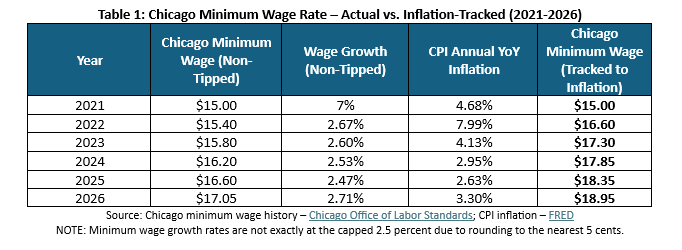
In 2019, the Chicago City Council reformed the minimum wage ordinance and fast-tracked a hike to $15 an hour. The city’s minimum wage now grows annually in accordance with Consumer Price Index (CPI) inflation, but is capped at no more than 2.5 percent, rounded up to the nearest 5 cents. As of July 2026, Chicago’s adult minimum wage is $17.05 per hour for non-tipped workers and $12.96 per hour for tipped workers.
While Chicago has the highest minimum wage of any city in Illinois, CPI inflation has exceeded 2.5 percent every year since the $15 per hour rate was hit in 2021. This means that Chicago’s minimum wage increases have been subsumed by inflation each year, with worker paychecks continuing to fall behind. With inflation once again expected to be above 2.5 percent this year, this pattern shows no signs of stopping. Table 1 shows that Chicago’s minimum wage workers would be earning $18.95 per hour right now instead of $17.05 if the minimum wage had actually kept pace with inflation—nearly $2 per hour more and equivalent to almost $4,000 annually for full-time workers.
More recently, there have been proposals to raise the Chicago minimum wage to as high as $22 per hour by 2032. Another minimum wage increase would have significant impacts for working-class Chicagoans. Table 2 shows the impact of an example $22 per hour proposal, which would give Chicago workers a $2.25 per hour raise by 2032 compared to expected inflation under current law.
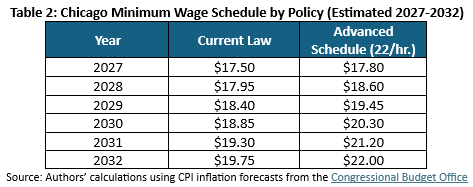
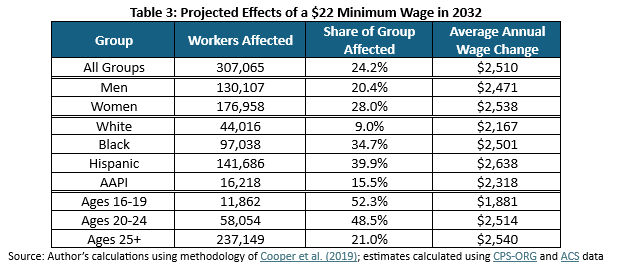
Table 3 goes further and shows the effect that a $22 per hour minimum wage by 2032 would have on thousands of Chicago workers. Under this potential policy, 300,000 Chicago workers would receive a raise compared to current expectations, earning an average of $2,500 more per year. Women, Black and Hispanic workers, and adults over 25 years old would represent the majority of affected workers. The increase would also boost earnings for 35 percent of Black workers and 40 percent of Hispanic workers in the city.
To ensure that these gains are not further eaten away by cost-of-living increases, the City of Chicago could consider removing the 2.5 percent limit on annual hikes and phasing out tipped minimum wages. This would help all workers keep pace with inflation. Alternatively, alders and the mayor could consider indexing wage rate increases to an entirely different metric than CPI inflation. For example, after a phased-in $22 per hour by 2032, Chicago could subsequently index future minimum wage values to two-thirds of the area’s median wage. This would provide structural, scheduled wage gains with no significant decreases in employment.
Critics of minimum wage reform routinely claim that increased labor costs lead to job losses and higher consumer prices, however the data makes clear that these objections are overstated. Research shows that minimum wage hikes account for less than 1 percent of total inflation, while total wage increases offset subsequent price increases to goods and services. Modern economic research also suggests that there is no significant job loss when minimum wages are raised, and that employment can actually increase in industries with highly concentrated labor markets.
Indeed, Chicago’s minimum wage ordinance could be an effective instrument for enhancing affordability for working families with minimal downside economic costs. At minimum, amidst a generational affordability crisis, there is cause for Chicago to revisit its minimum wage ordinance. The 2019 reforms for $15 per hour were a step in the right direction, but the largest inflation surge in decades has left many working-class Chicagoans behind. Ultimately, the data shows that an accelerated increase in the minimum wage schedule would give more Chicagoans pay raises than under current law, make their lives in the Windy City significantly more affordable, and pose minimal downside economic risks.