
Blog
By Jacob Hager
Home prices nationally have grown by 46% since March 2020 due to strong employment growth, a lack of homes for sale on the market, a growth in large institutional investors buying up properties with cash, and barriers to building and development. Illinois in particular faces a critical shortage of 142,000 homes that has led to rising housing costs, with the Chicago area in particular experiencing higher increases in home prices and rents than the national average.
However, a recent study by the Federal Reserve Bank of Dallas got considerable press coverage last month for introducing a new potential driver of housing costs: immigration. President Donald Trump posted about the paper on his social media platform, claiming that it provides proof that undocumented immigrants are the primary cause of the housing affordability crisis. Misleading soundbites are being created from a particular finding that the President erroneously cited, claiming that undocumented migration “drove up home prices 30%.”
Many using this research paper as ammunition for anti-immigration politics are misunderstanding both the Federal Reserve’s research findings and the economic drivers behind them. Federal Reserve Bank of Dallas economists studied the impact of undocumented migration on the housing market and labor market. The paper’s authors found that it increased demand in a supply-constrained housing market, causing a slight increase in home prices and rents in metropolitan areas. While they found that this effect contributed less than 7% of home price gains from 2021 to 2024, home prices and rents grew by 22% to 23% over the same period. This means that the vast majority of housing cost increases came from other sources.
This is where the study’s additional labor market findings come in handy for actually explaining home price increases since 2020. Interestingly, the study found no evidence of undocumented worker inflows spurring an expansion of the housing supply. This is contrary to what other research papers have found, with migration inflows lowering lower housing prices through an increase in construction sector employment. The Dallas Fed’s findings follow the trend illustrated in Figure 1, in which residential construction employment has shrunk since the beginning of 2025.
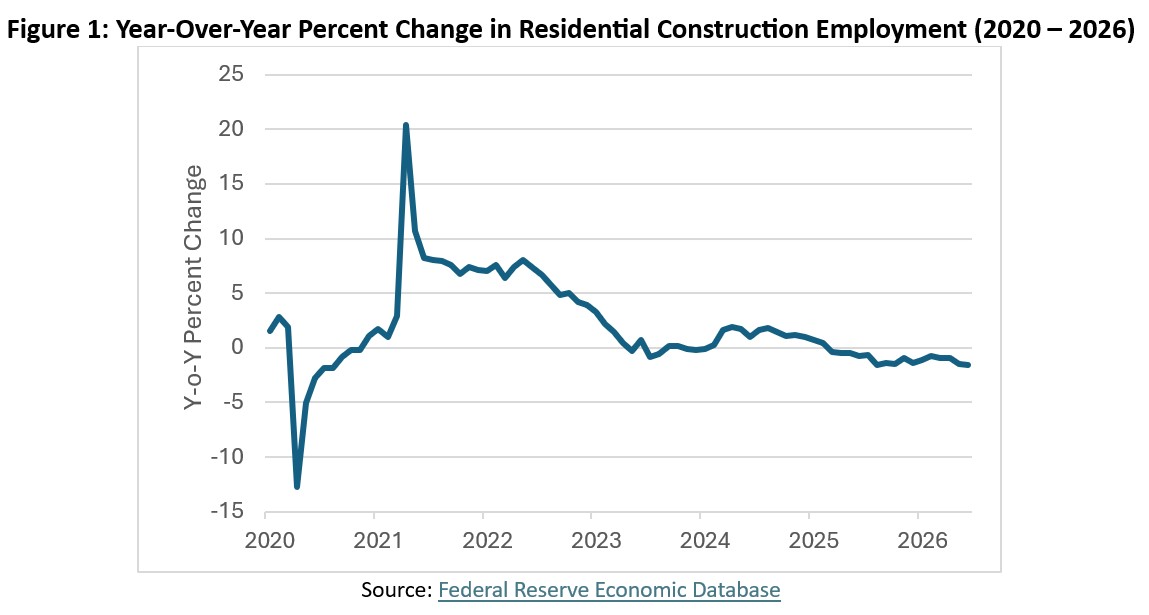
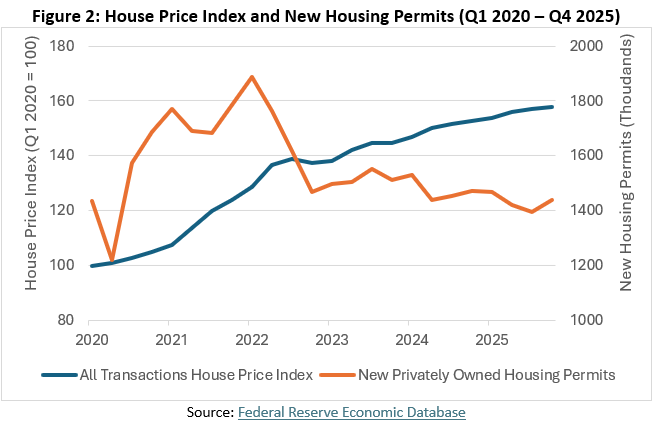
A lack of construction employment growth translated into a lack of new houses being built—exactly what this paper’s methodology is illustrating. This absence of new residential construction is also captured using data for newly issued housing permits from 2021 through 2024. Figure 2 shows that the rate of new housing permits issued nationally has stayed relatively stagnant since the pandemic, despite population growth. To put it simply, the data shows that even with an influx of new workers, the United States has not been building the housing supply necessary to keep up with demand, especially since 2022—leading to an estimated shortage of 3.4 million units nationwide.
More recent data from Zillow, the source used by the Dallas Fed, undermines any conclusion that immigration and home prices are linked. For example, over the year from June 2025 to June 2026, home prices rose 1% nationally, but by 5% in Chicago and 4% in New York City. In these two areas, foreign-born residents make up larger shares of the population (19% and 31% respectively) than the national average (15%). If immigration drove up home values prior to 2025, then the recent crackdown since 2025 would be expected to bring prices down while disproportionately impacting Chicago and New York. That has not occurred.
The study also did not account for two big factors that have driven up home prices. First, it did not include the rise of remote work. Researchers at the Federal Reserve Bank of San Francisco and the Federal Reserve Bank of Philadelphia have found that work-from-home arrangements boosted housing demand and increased home prices by 15%. Second, the authors ignore the jump in mortgage rates from an average below 3% in 2021 up to 6% or higher since 2023. This “lock-in effect” has caused homeowners who would otherwise prefer to upgrade their housing situation to stay in their homes because moving would force them to trade a historically low mortgage rate for a much higher current rate. The lock-in effect has reduced the supply of homes available on the market, directly causing a 7% increase in home prices. Omitting these two dynamics, which together may account for 22% of the rise in home prices, is a major red flag for the Dallas Fed’s results.
Finally, a recent study by the Illinois Economic Policy Institute and the Project for Middle Class Renewal at the University of Illinois at Urbana-Champaign found that housing affordability can best be tackled by focusing on housing supply, addressing the stagnant rate of new residential permits rather than reducing housing demand. In Illinois, every 1% increase in household building permits decreases home prices by nearly 3%. This study also found that increases in immigration had no significant effect on home price growth, while home price increases were primarily fueled by employment growth and a lack of new builds.
The solution to the housing affordability crisis cannot be found by blaming immigrants. Instead, states can make owning a home or renting more affordable for everyone by implementing a number of reforms to expand housing supply, such as easing zoning restrictions to build more multifamily residences, reducing minimum parking requirements, and streamlining permitting processes and timelines. Cracking down on immigration and deporting migrants to reduce housing demand would be missing the forest for the trees, based on a misunderstanding of economic data and an incomplete picture of housing market dynamics.