
Blog
By Jacob Hager
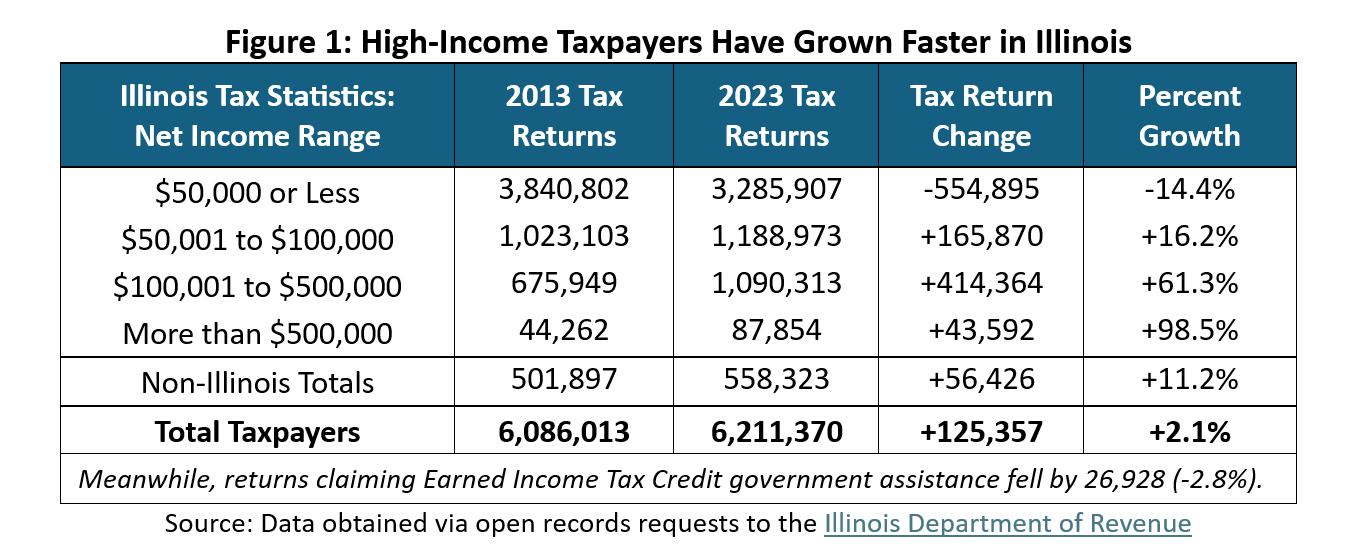
Illinois’ population and Illinois’ taxpayers are growing. Despite persistent rhetoric from naysayers, the number of people in Illinois has increased for three consecutive years—adding up to more than 100,000 new residents since 2022. In the decade spanning 2013 to 2023, Illinois also added over 125,000 taxpayers.
High-income earners are the fastest-growing group in Illinois (Figure 1). While households in the middle-class grew 16% from 2013 to 2023, those making over $500,000 per year doubled (+99%) across the state. The only tax bracket that shrunk was low-income households. While this is in part due to a rising minimum wage as people “graduate” out of the lowest income bands, it is also due to the truth about who leaves Illinois, who moves here, and who chooses to stay.
Illinois has the 8th most regressive state and local tax system in the country. This means that it favors higher earners, who pay less in taxes than middle-class and working families. This is especially true for property taxes: middle-class families contribute between 4% and 7% of their taxable incomes toward property taxes, while millionaires pay less than 1%.
Multiple proposals have been offered to remedy the inherent unfairness of the system. First, a “Fair Tax Amendment” that would have introduced a graduated tax structure was unsuccessful in 2020. This year, a 3% surcharge on annual income over $1 million was considered while keeping the rest of the flat income tax structure in place. This “millionaires’ tax” would have impacted about 40,000 households—less than 1% of all tax filers in Illinois—but would not have applied to retirees, retirement or investment accounts, or home sales.
The millionaires’ tax would have generated $4 billion annually by 2029 and $5 billion annually by 2034 in in new, “lock-boxed” revenue dedicated for property tax cuts of up to 20% or historic investments in public schools. This property tax relief and commitment to education would have boosted the economy and made Illinois a more attractive place to live for working and middle-class families. Despite 61% of voters advising state lawmakers “to create an additional 3% tax on income greater than $1 million for the purpose of dedicating funds to property tax relief” as recently as 2024, the General Assembly failed to put a millionaires’ tax on the ballot this November.
Some lawmakers worried that shifting the tax burden onto high-income earners would cause millionaires to migrate out of state. Groups spreading this myth are often financially backed by multimillionaires and billionaires themselves. They even use data from the Internal Revenue Service (IRS) to look at a portion of the migration picture and claim that “billions” of dollars are being lost.
Here’s the problem: Not only are high-income earners the fastest-growing group in Illinois, but economic research is clear that surtaxes do not cause millionaires to leave the state. Studies find that millionaires move at lower rates than the rest of the population—with higher taxes having statistically insignificant impacts on outmigration. That’s because millionaires are more likely to have business ties in their communities and more likely to be married with children, making them more “embedded” than other residents.
This millionaire migration myth withers away under scrutiny. Since enacting a 4% surcharge on annual incomes over $1 million, Massachusetts has grown its millionaire population by 39% and collected $3 billion more in new annual tax revenue which is now being invested in education, tuition-free community college, and infrastructure. Despite raising its top marginal tax rate in 2022, Washington D.C. also saw a 23% increase in millionaires.
Even IRS data that these billionaire-backed groups use shows that 7-in-10 people who move out of Illinois earned less than $200,000 per year (Figure 2). Illinois’ outmigration is primarily a story of middle-class and working families exiting—not millionaires.
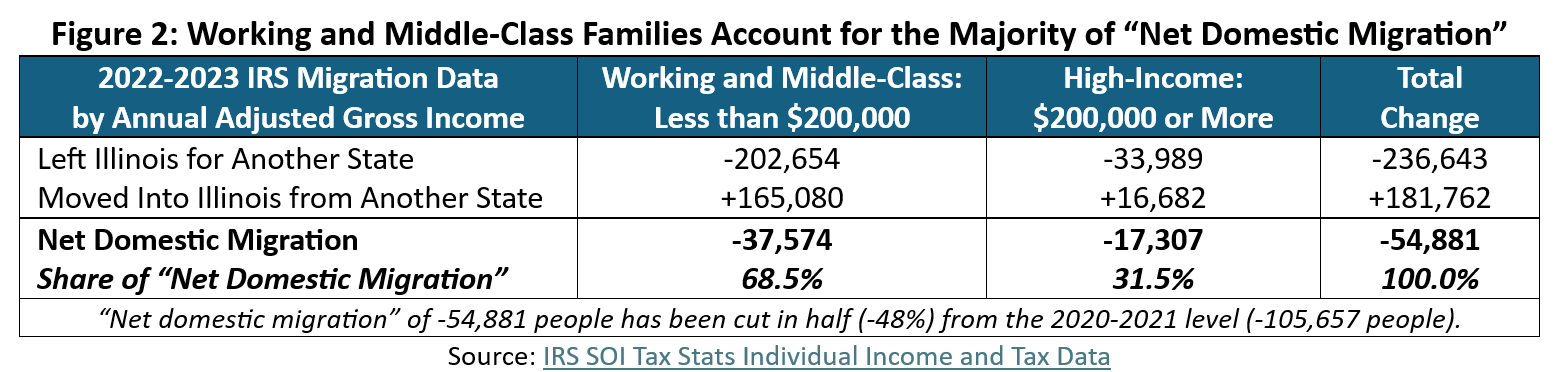
It also must be mentioned that “net domestic migration” is only one aspect of the change in taxpayers or population. It does not account for people who stay in-state and enter the top-earning bracket thanks to salary changes, improved capital gains, and record small business profits. It also doesn’t account for natural change or migration from abroad. For example, many cities in states without income taxes, from Miami to Memphis, are now losing people while Chicago’s population is growing. Failing to see the bigger picture while focusing just on “net domestic migration” and tax rates can lead to misguided policy changes.
The reality is that Illinois is a low-tax state for wealthy households and a high-tax state for everyone else—a backwards framework this has hindered Illinois’ population growth. A millionaires’ tax could still be considered and put on the ballot as soon as 2028. If passed, it would make the tax system more competitive for working and middle-class families, enable historic investments in public education, and provide property tax relief—all without high-earner tax flight. Getting property taxes under control and creating better schools for students would attract more people to Illinois and deliver a much needed boost the state’s economy.