
Reports
By Frank Manzo IV and Robert Bruno
Media contact: Todd Stenhouse, 916-397-1131, [email protected]
La Grange, IL: Tier 2 pensions in Illinois have reduced retirement benefits for public service workers and have been linked to both growing shortages of essential employees and a brewing conflict with federal law. A new analysis by the nonpartisan Illinois Economic Policy Institute (ILEPI) and the Project for Middle Class Renewal at the University of Illinois at Urbana-Champaign (PMCR) shows that reforms to improve benefits would grow the economy and create thousands of jobs, while being mostly or entirely paid for by repurposing expiring debt payments.
Read the report, Reforming Tier 2 Pensions in Illinois: Impacts on Workers, Taxpayers, and the Economy.
“Illinois’ public employees already earn as much as 20% less than their private sector counterparts and have seen substantial drops in retirement earnings since Tier 2 went into effect, despite about half not receiving Social Security benefits,” said study co-author and ILEPI Economist Frank Manzo IV. “With a growing shortage of teachers, nurses, and other essential workers, the data shows that reforming Tier 2 can boost the quality of public service jobs and stimulate economic growth at minimal cost to taxpayers.”
Though the Commission on Government Forecasting and Accountability found that decades of underfunding by State lawmakers, economic recessions, and unrealistic investment assumptions are responsible for the vast majority of the State’s unfunded pension liabilities, Tier 2 was enacted to slow their growth by cutting benefits. Tier 2 has imposed a higher retirement age, smaller salary bases for determining benefits, and significantly lower cost-of-living increases for workers hired since 2011.
The report details how these changes now cost the average Illinois public service worker at least $2,600 per year in retirement earnings and $174,000 in cumulative benefits over 15 years. Notably, the share of university graduates in Illinois pursuing education or teaching-related degrees since the implementation of Tier 2 has dropped by 40%. Meanwhile, teaching and public school staff vacancies have nearly tripled since 2017. Since 2021, State agencies have had historically high vacancy rates as well, with between 5,000 and 8,000 positions going unfilled every year.
Researchers also found that a growing number of public service workers—representing 6% of the current workforce—are set to earn less from State retirement checks under Tier 2 than they would if they had paid into Social Security instead. This could expose the State to lawsuits, push the system out of compliance with federal law, and leave workers and taxpayers each having to pay 6.2% toward Social Security contributions in addition to annual pension contributions.
“Tier 2 appears to not only be contributing to recruitment and retention problems for public employers, but it could be adding costs by inviting conflict with federal law,” said PMCR Director and University of Illinois at Urbana-Champaign Professor Dr. Robert Bruno. “While inadequate State contributions causing explosive growth in unfunded liabilities have been ended under Governor Pritzker, the data shows that additional reforms can address problems that have emerged since 2011 without cannibalizing other public investments—and without raising taxes.”
Researchers assessed the potential fiscal and economic impacts of four different options for reforming Tier 2, each of which would improve benefits paid to future retirees. These include:
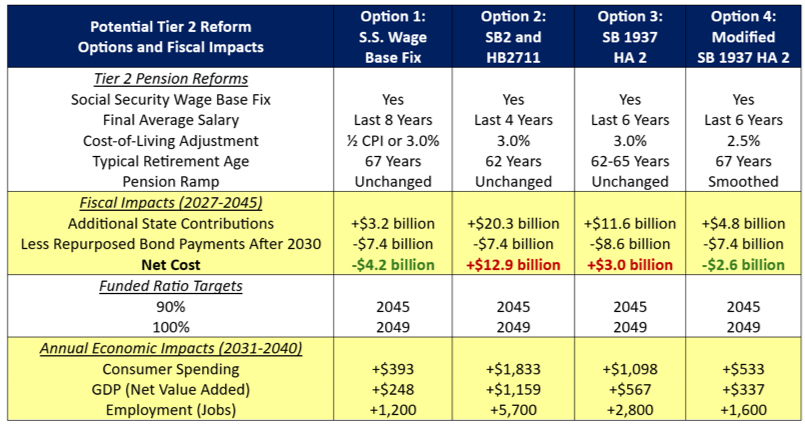
To fund the reforms, researchers noted that the Fair Retirement and Recruitment Act calls for repurposing funds from bonds that had been used to address the bill backlog following a two-year budget impasse, as well as from expiring Pension Obligation Bonds. The former will be fully paid off in 2030 and the latter in 2033. In their report, ILEPI and PMCR researchers modeled four scenarios where some of these expiring bond payments could be used to fund reform.
“Repurposing legacy bond payments could help pay for Tier 2 reforms,” Manzo said. “This fiscally-responsible and credit-neutral approach would not only address the needs of workers, but it would also keep the State on track to meet its long-term funding targets and could even save money for taxpayers. By increasing retirement income for residents on fixed incomes, reforms would translate into more spending on goods and services across all sectors of the economy.”
The two existing legislative proposals—options 2 and 3 above—ranged in new costs from $3 billion to $13 billion over 18 years, after incorporating funding from repurposed bond payments. Across all scenarios, researchers found that reforms would resolve potential conflicts with federal law and boost benefits for Tier 2 employees by between $400 million and $1.8 billion per year. Industry-standard IMPLAN analysis further revealed that the ripple effects of these reforms would grow the economy by anywhere from $250 million to $1.2 billion per year, creating 1,200 to 5,700 jobs.
“A healthy public pension system is a vital tool for attracting and retaining teachers, police officers, firefighters, nurses, and other essential workers who serve our communities,” Bruno concluded. “With Tier 2 deepening the public sector pay penalty, the data makes a strong argument for reforms that can improve job quality and maintain our current funding trajectory without increasing taxpayer burdens. Tier 2 pension reforms would set us on a path to achieve these goals by putting money that was previously used to service debts back in the hands of Illinois’ working families.”