Blog
Eliminating the Public Service Loan Forgiveness (PSLF) Program and the Community Development Block Grant (CDBG) Program would Hurt Students, Low-Income Families, and the Illinois Economy.
The federal government plays a prominent role in supporting education and promoting economic development. However, two new reports from the Illinois Economic Policy Institute (ILEPI) and the Project for Middle Class Renewal (PMCR) at the University of Illinois at Urbana-Champaign find that recent proposals by Congress and the Trump Administration will undermine these objectives by putting the interests of billionaires and corporations ahead of working families.
Nonpartisan analysts have already noted that the tax cut plans proposed in Congress benefit the wealthy significantly more than students, low-income individuals, and the middle class. In Illinois, the richest one percent would receive 46 percent of the proposed tax cut recently introduced in the U.S. House of Representatives. The plans released in both the House and the Senate have each received a failing grade from higher education groups because they would eliminate tax credits for education– including the student loan interest deduction and the business deduction for education-assistance plans– and levy new taxes on tuition waivers, which would impact 145,000 graduate students who receive waivers to cover tuition.
Matched with other administration priorities, such as a dramatic boost to defense spending, the tax cut proposals would raise the federal budget deficit by about $1.5 trillion and will need to be offset either by spending cuts or by increases in other taxes over the long run. If tax cuts are financed by eliminating essential public programs, then low-income and middle-class families will be negatively impacted. The following reports illustrate the potential consequences for Illinois following the elimination of the Public Service Loan Forgiveness (PSLF) program and the Community Development Block Grant (CDBG) program, as were indicated in President Trump’s proposed budget.
The Consequences of Abolishing the Public Service Loan Forgiveness Program
One of President Trump’s proposed budget cuts pertains to the Public Service Loan Forgiveness (PSLF) program, which would be eliminated for individuals who take out student loans on or after July 1, 2018. The PSLF program subsidizes federal student loan repayments for workers employed in the public sector and by eligible nonprofit organizations to encourage individuals to work in public service occupations.
The Elimination of the Community Development Block Grant (CDBG) Program
The Trump Administration’s fiscal year 2018 budget proposal included the complete elimination of the CDBG program as part of $6.2 billion in cuts to the U.S. Department of Housing and Urban Development (HUD). The CDBG program is a federal block grant that gives state and local governments access to flexible funding for infrastructure projects, economic development initiatives, housing rehabilitation programs, and critical public services to help low-to-moderate income people.
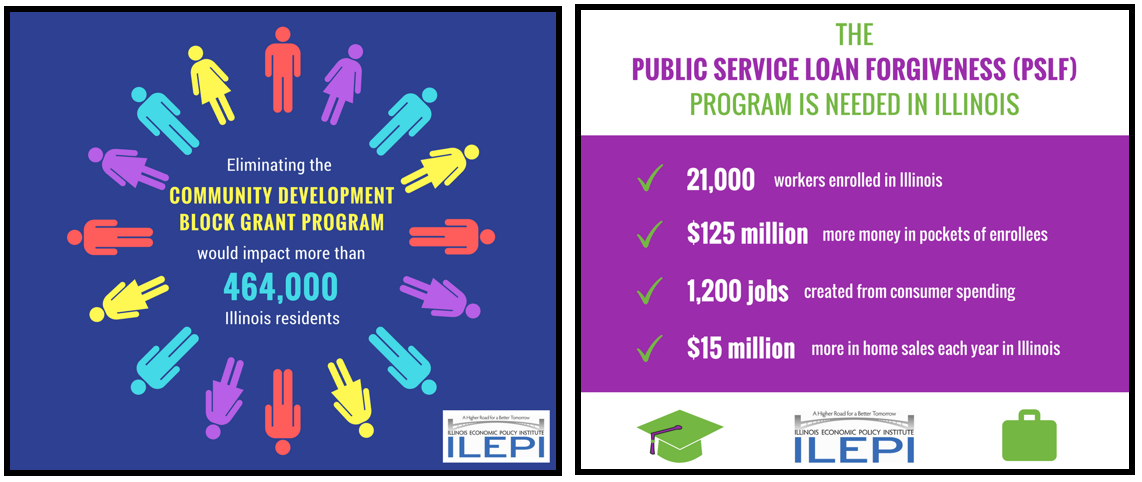
The Trump Administration and Illinois’ congressional delegation must consider the negative economic impacts of paying for a $1.5 trillion tax cut that disproportionately benefits the wealthy on the backs of working families, students, and other vulnerable populations. Specific cuts to the Public Service Loan Forgiveness and Community Development Block Grant programs, for example, would leave millions of students, low-income individuals, veterans, elderly persons, and middle-class families without the financial assistance and vital care that they need- and would harm the Illinois economy.
Please read the Executive Summary of the two reports here.
Please read the full report on the Public Service Loan Forgiveness (PSLF) program here.
Please Read the full report on the Community Development Block Grant (CDBG) program here.