

While Unionization Rates Continue to Fall, Researchers Contend that Job Growth in New Industries and Rising Public Sector Staff Vacancies Driving National Trends
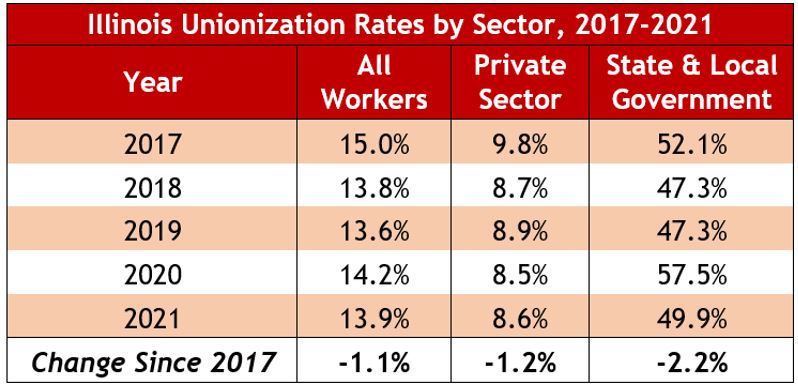
La Grange: Last year, as the number of union members in the U.S. workforce grew for the first time since 2017, Illinois saw its largest number of new union organizing petitions since 2014 and organized more workers than at any time in the last decade, according to new data compiled by the Illinois Economic Policy Institute (ILEPI) and the Project for Middle Class Renewal (PMCR) at the University of Illinois Urbana-Champaign. Nevertheless, the growth of new industries that have yet to organize and a rise in vacant positions in the highly unionized public sector resulted in a decline in unionization rates in Illinois and nationally.
“From public approval of unions remaining at six-decade highs to significant growth in union membership nationally to a surge in successful new union organizing petitions in Illinois, the data offers good news for the labor movement,” said report coauthor and ILEPI Economist Frank Manzo IV. “That said, it also reflects broader labor market trends—including an economy in transition that is adding more low-paid service jobs and more lucrative knowledge-based opportunities with low union densities and a big increase in staff vacancies in traditionally unionized state and local government positions.”
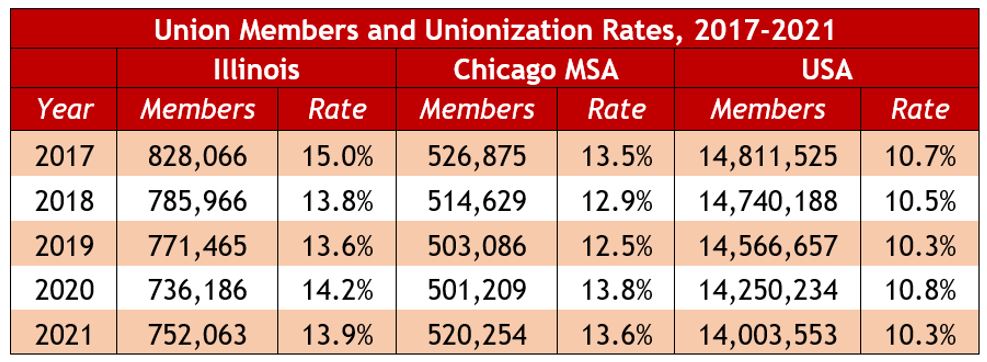
Analyzing data from the National Labor Relations Board and the Current Population Survey from the Bureau of Labor Statistics at the U.S. Department of Labor, researchers found that, despite substantial recent success in new union organizing drives, both Illinois and the Chicago area lost union members last year—even as the number of workers nationally who were dues-paying members increased for the first time since 2017. All three regions saw decreases in the shares of their workforces who were union members.
Overall, the report notes that Illinois has the nation’s 12th-highest unionization rate, with its workers far more likely to be union members than the nation as a whole. While Black workers, military veterans, workers with master’s degrees, and people employed in the public sector or in construction are the groups most likely to be unionized, the report notes that younger workers aged 25-34 years old have seen growth in their unionization rate (+2.3 percentage points), while unionization rates amongst older workers have generally declined.
The report also finds that unions boost worker earnings by 12% in Illinois, the 5th-highest impact in the nation. Effects are largest for middle-class workers, with unions increasing wages by 14% for the median Illinois worker.
But the report’s authors cautioned that macro-level data can paint an incomplete picture on the state of union organizing and the labor market both in Illinois and the United States. They highlighted a substantial 78% increase in job vacancies in historically unionized state and local government positions since the Supreme Court imposed so-called “right-to-work” conditions on these jobs nationwide in 2018, which was 25 percentage points more than in the private sector during this period. For its part, Illinois has seen a 164% increase in unfilled positions at public school districts since 2017. Fully 13% of state government jobs sat unfilled in 2022.

“Research has strongly correlated ‘right-to-work’ conditions with an erosion of wages and job quality because these changes reduce the resources that unions would otherwise have available to bargain on behalf of their members,” said study coauthor, University of Illinois at Urbana-Champaign Professor, and PMCR Director Dr. Robert Bruno, Ph.D. “And surveys show high dissatisfaction with wages as a leading culprit for the recent spike in public sector job vacancies. There is no question that when thousands of jobs normally performed by union members sit unfilled, it distorts the overall union membership picture.”
Indeed, the report’s authors detailed how unionization rates, average wages, and wage growth were generally higher in states that protect collective bargaining rights than in peer states that have passed “right-to-work” laws. For example, states that protect collective bargaining rights have seen hourly earnings grow 5% faster since 2013. Hourly earnings also grew 9% faster in Illinois than in Indiana, Iowa, Kentucky, and Wisconsin during that time, and unions retained more members in Illinois than in these four neighboring states with “right-to-work” laws.
“The data reveals a strong correlation between labor policies and both job quality and unionization rates,” Manzo concluded. “Despite a polarizing economy and recent Supreme Court decisions, it is clear that states that protect collective bargaining rights see better economic outcomes and more organizing. By passing the Workers’ Rights Amendment to guarantee a constitutional right to bargain collectively, Illinois is well positioned for union membership growth over the next decade as the labor market stabilizes and expands.”
The Illinois Economic Policy Institute (ILEPI) is a nonprofit organization which uses advanced statistics and the latest forecasting models to promote thoughtful economic growth for businesses and working families.
The Project for Middle Class Renewal (PMCR) at the University of Illinois investigates the working conditions of workers in today’s economy to elevate public discourse aimed at reducing poverty, create more stable forms of employment, and promote middle-class jobs.