

34% say they plan to leave profession in next 12 months, but most would stay if Illinois enacted a law mandating staffing ratios for Registered Nurses
La Grange, IL: A systemic staffing crisis marked by widespread labor shortages continues to plague Illinois’ healthcare workforce according to a new survey of Illinois Registered Nurses by the non-profit organization Nurses Take DC that was analyzed by researchers at the Project for Middle Class Renewal at the University of Illinois at Urbana-Champaign and the Illinois Economic Policy Institute (ILEPI). Over half of the Illinois registered nurses are over age 55, the state is projected to see an RN shortage of 15,000 by 2025, and the survey found that 34% of existing RNs say they plan to leave the profession in the next twelve months.
“While surveys at the height of the COVID Pandemic revealed alarming staffing shortages, horrific levels of moral distress, and substantial attrition within the workforce, this survey offers a new post-pandemic baseline,” said PMCR Director, University of Illinois at Urbana Champaign Professor and report Co-Author Dr. Robert Bruno. “The bottom line is that the underlying conditions that nurses faced during the pandemic have not abated, and additional institutional or policy interventions are likely needed to retain this critical segment of the labor force and protect the quality of care offered to patients.”
The report is based on responses to 60 survey questions from 385 registered nurses across Illinois, administered by the nonprofit organization Nurses Take DC between October 2022 and February 2023. The survey sample was generally representative of Illinois overall nursing workforce by age and gender and slightly more diverse by race and ethnicity.
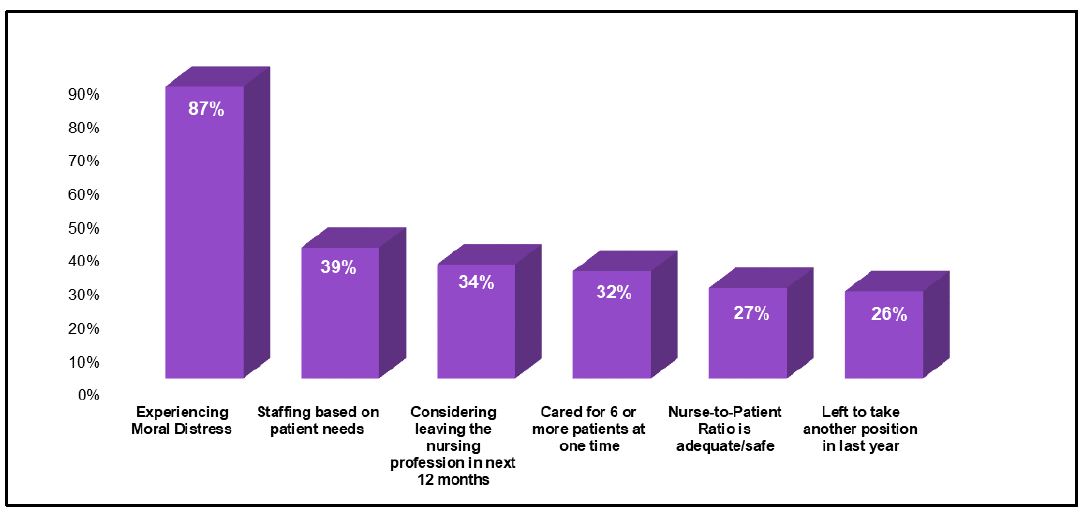
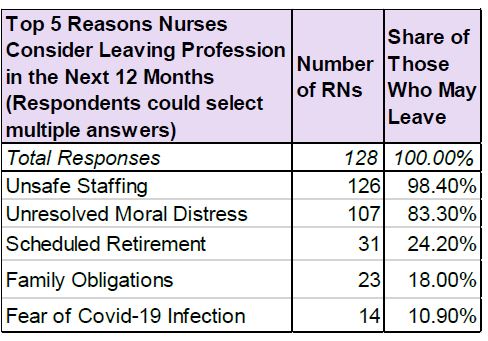
Topline results showed persistent concerns about heavy workloads that were not based on patient needs, a lack of awareness about laws that require the use of labor-management committees to ensure adequate staffing levels, and feelings of “moral distress” (or feeling that the ethically correct action has not been pursued due to organizational or institutional constraints). Indeed, inadequate staffing levels and unresolved moral distress were the two most common reasons given by the 34% of respondents who said they were considering leaving the profession in the next twelve months.
Prior national surveys have showed that states adopting minimum nurse-to-patient ratios (also called “safe patient limits”) have substantially reduced the share of nurses reporting that they must care for 6 patients or more as well as rates of moral distress and the share of nurses considering leaving the profession shrank by 6 percent. Importantly, research has also shown that these initiatives do not harm the financial performance of hospitals and can actually cut health care costs by reducing “adverse patient events, readmissions and length of stays.” One recent study showed that revenue and employment growth at California hospitals exceeded national averages by 33% and 45% respectively after the state enacted the nation’s first safe patient limits law.
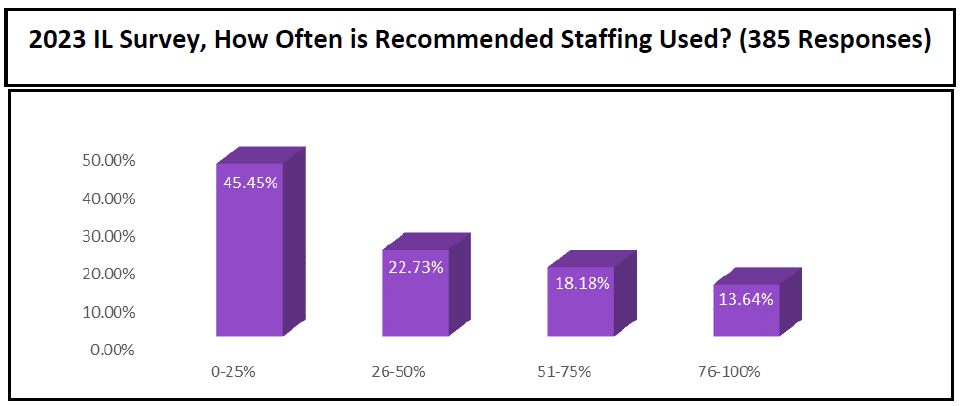
While Illinois is one of eight US States that has a law requiring hospitals to have a staffing committee and policy in place, survey results indicate that these committees are neither widely understood, nor widely utilized. Strong majorities of survey respondents indicated that they were not aware of the presence of a staffing committee (53%), did not believe staffing levels were based on patient needs (61%), did not have staffing levels reassessed based on changes in patient needs (69%) and reported that staffing committee recommendations were not implemented nor regularly re-evaluated to determine their effectiveness.
“To understand the needs of those who devote their lives to delivering health services, it’s especially important to understand the downstream effects of understaffing,” added ILEPI Research Associate and Study Co-Author Grace Dunn. “The survey reveals an especially high incidence of moral distress felt by nurses, which very often manifests into medical or mental health conditions that undermine both job satisfaction and patient care quality.”
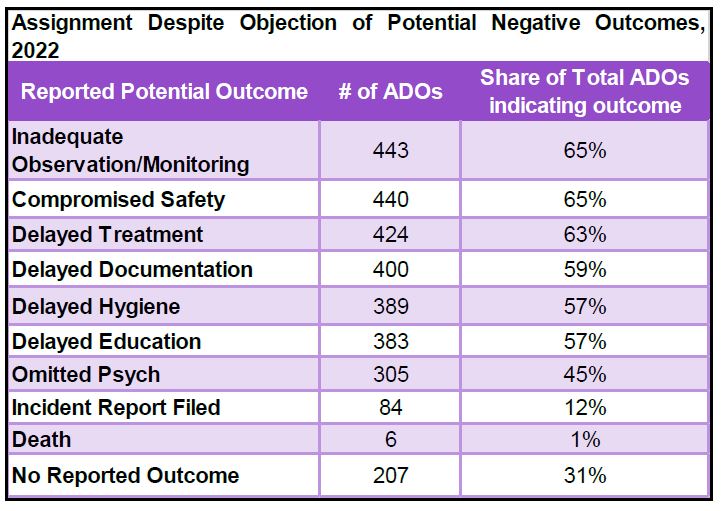
Specifically, Dunn pointed to survey results showing almost ninety percent of nurses reporting moral distress at work, fully two thirds describing themselves as “depressed,” and nearly half (48%) saying that it has left them experiencing medical or mental health issues for which nearly thirty percent (30%) of respondents said they had sought professional care. The report also includes an analysis of 677 “Assignment Despite Objection” (ADO) forms from five Ascension and AdventHealth hospital systems in Illinois between January and November 2022 that detailed understaffing as the most common issue being reported by nurses—with potential negative outcomes ranging from compromised safety and delayed treatment, to omission of psychological support and death.
Report authors noted that while survey responses show that Illinois’ nursing environment is facing persistent issues that are driving workers away from the profession, they are also offering clear recommendations that could help reverse these trends.
“More than three quarters of all respondents said that a law mandating nurse staffing ratios, improved pay, or a better mix of professional and ancillary staff would draw them back into the profession,” Dr. Robert Bruno added. “This tells us that while the current survey results are real cause for concern, there exists a path to better patient and labor market outcomes. By hearing and responding to the voices closest to patients, we believe that policy makers and health administrators can ensure that today’s crisis doesn’t become a new long-term baseline for our health care system.”
The Illinois Economic Policy Institute (ILEPI) is a nonpartisan nonprofit research organization which uses advanced statistics and the latest forecasting models to promote thoughtful economic growth for businesses and working families in Illinois and across the Midwest.
The Project for Middle Class Renewal (PMCR) at the University of Illinois at Urbana-Champaign investigates the working conditions of workers in today’s economy to elevate public discourse aimed at reducing poverty, create more stable forms of employment, and promote middle-class jobs.