

Annual Report Shows Labor Gaining Strength in Private Sector, Despite Public Sector Losses Following Janus Decision
Chicago: Though a 2018 Supreme Court decision and so-called “right-to-work” laws have continued to negatively impact union membership, the U.S. added union members for the second straight year in 2023 while Illinois saw its highest number of successful union petitions in a decade—according to the annual State of the Unions report by the nonpartisan Illinois Economic Policy Institute (ILEPI) and the Project for Middle Class Renewal (PMCR) at the University of Illinois at Urbana-Champaign. Additionally, fresh off the passage of the Workers’ Rights Amendment to the Illinois Constitution in 2022, both Illinois and the Chicago metropolitan area saw gains in their private sector unionization rates. The data, which comes as unions continue to enjoy high levels of approval in public polling, also shows that union membership has positive effects on worker earnings.
“Against legal and structural headwinds that have depressed the nation’s overall unionization rate with disproportionate impacts on the public sector, the data suggests that organizing activity is beginning to align with a transitioning economy,” said ILEPI Economist and report coauthor Frank Manzo IV. “In Illinois in particular, a two-year surge of new organizing petitions and significant year-over-year growth in the private sector unionization rate is suggesting that public approval of unions is beginning to take root in new industries and previously unorganized workplaces.”
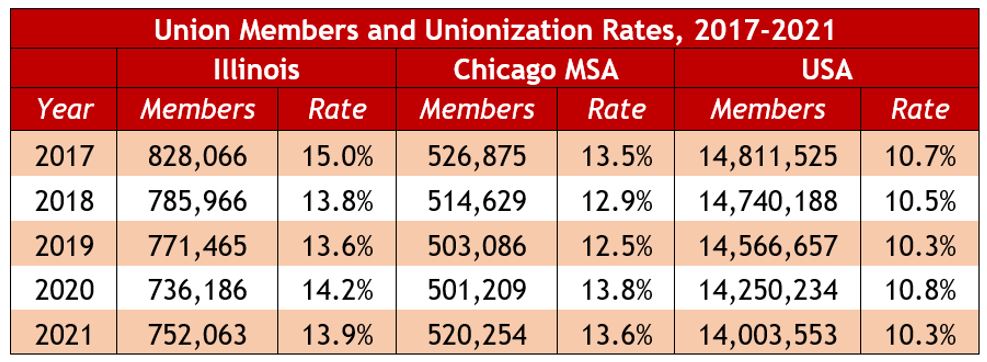
Researchers analyzed data from the National Labor Relations Board and the Current Population Survey from the Bureau of Labor Statistics at the U.S. Department of Labor. The data reveal that in 2023, the first full year of data since passage of the Workers’ Rights Amendment to its State Constitution, Illinois had its most successful year for new union organizing petitions than any other time over the last decade. Furthermore, Illinois organized more new union members over the past two years (13,896 members) than the preceding five years combined (12,864 members).
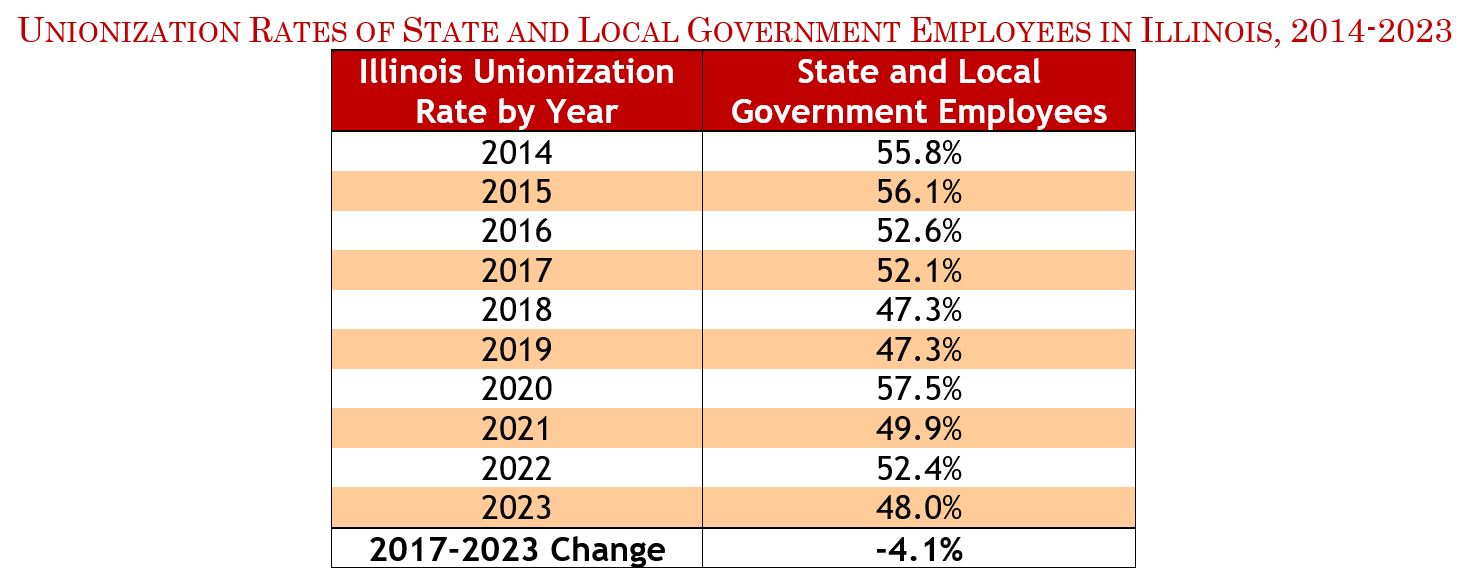
Despite these signs of resurgence, researchers noted that the overall rate of unionization in both Illinois and the nation as a whole continued to decline, driven by the loss of membership in the heavily unionized public sector following the Supreme Court’s 2018 Janus decision that imposed “right-to-work” conditions on public sector employees nationally. “Right-to-work” conditions require unions to provide services and representation to non-members for free. Both Illinois’ and the nation’s public sector unionization rates have declined since this decision, with Illinois’ state and local government unionization rate dropping by 4 percentage points.
“Research has long established a link between so-called ‘right-to-work’ laws and lower rates of union membership as well as lower incomes, and this pattern continues to be borne out in the data of this report,” added University of Illinois at Urbana-Champaign Professor and PMCR Director Dr. Robert Bruno. “Compared to neighboring states with these laws, Illinois enjoys a much higher union membership rate and faster wage growth.”
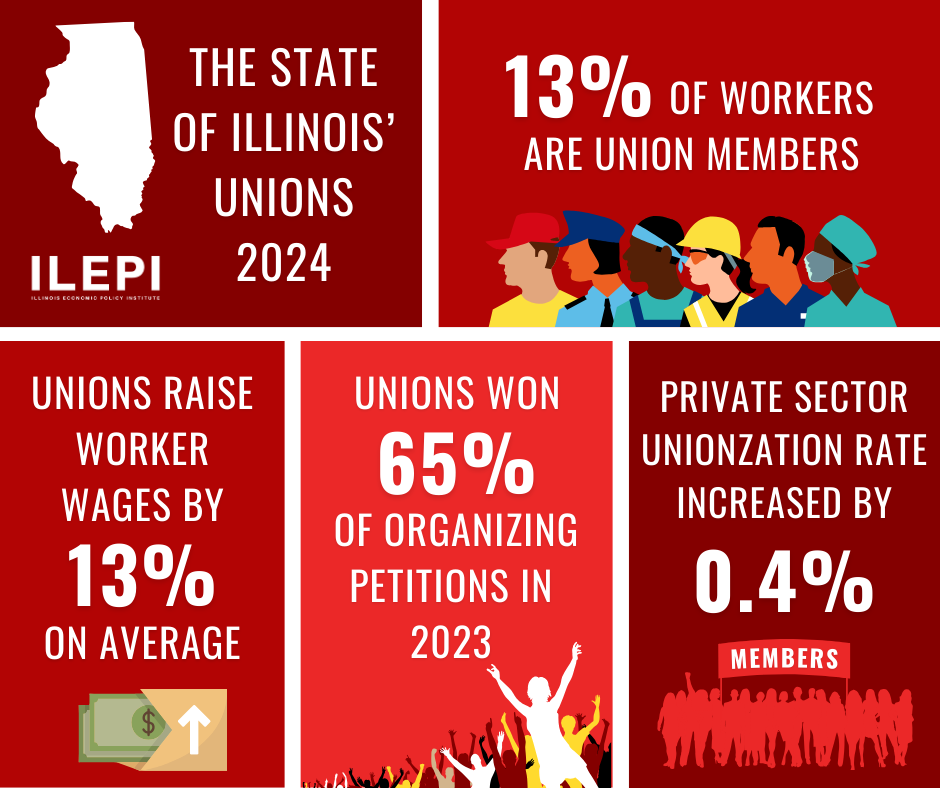
At 13%, Illinois currently has the nation’s 13th-highest unionization rate, with its workers 3 percentage points more likely to be union members than the nation as a whole. Black workers, military veterans, workers with master’s degrees, public sector employees, and construction trades workers continue to be the groups who are most likely to be unionized. Unions also boost worker earnings by an average of 13% in Illinois, which is the 3rd-highest impact in the nation. Finally, the report found that Illinois’ unionization rate was 5 percentage points higher than neighboring states with so-called “right-to-work” laws, while its worker wages had grown 5% faster since 2017 and were now an average of 19% higher.
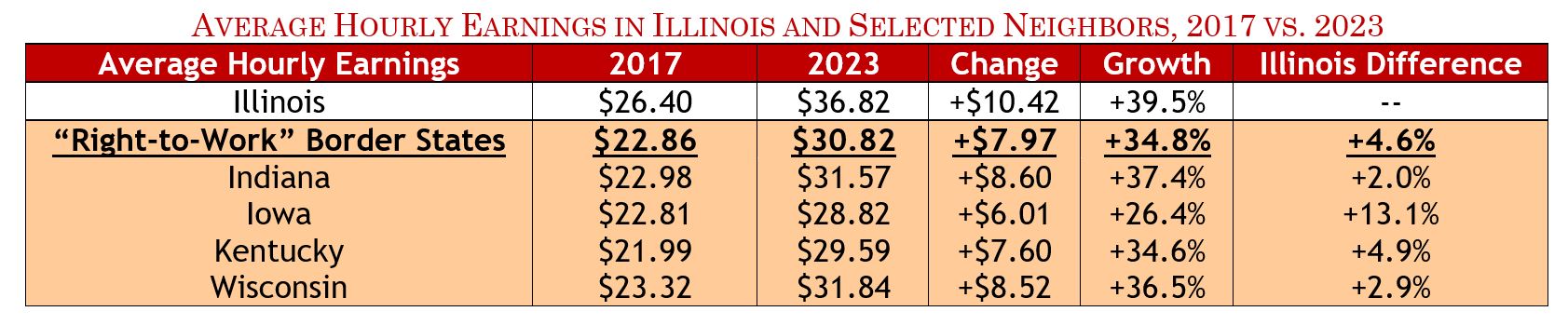
“The data shows that union members have been better able to withstand recent inflationary shocks than nonunion workers,” added Manzo. “And workers have generally fared better in states that have sought to protect workers’ rights to collectively bargain, like Illinois, than in states that chose to adopt so-called ‘right-to-work’ policies.”
The report’s authors cautioned that macro-level data have generally painted an incomplete picture on the state of union organizing, both in Illinois and the United States. They highlighted pandemic-related disruptions, the growth of traditionally non-unionized professional, management, and e-commerce sectors, and the acute labor shortages and staffing reductions in the historically unionized public sector as significantly altering the labor market.
“The combination of new investment in emerging industries and a workforce more attuned to the link between unions and job quality is bringing change to workplaces across America,” added Dr. Bruno. “While structural and legal challenges continue to create headwinds for unions in the public sector, it is clear that significant gains in the private sector are possible, especially when workers’ rights to organize are protected.”
The Illinois Economic Policy Institute (ILEPI) is a nonprofit organization which uses advanced statistics and the latest forecasting models to promote thoughtful economic growth for businesses and working families.
The Project for Middle Class Renewal at the University of Illinois investigates the working conditions of workers in today’s economy to elevate public discourse aimed at reducing poverty, create more stable forms of employment, and promote middle-class jobs.